
Nevada Has No Public Statewide Active-Warrant List
Nevada keeps its active warrants out of any public statewide search. Nobody can type a name into one state site and see every open warrant, because NCJIS and the National Crime Information Center serve only authorized justice users. Nevada court technology can move warrant data into the state repository, but the public materials name neither every participating court nor every covered warrant type, and they promise nothing about how complete any index is. That gap shapes how you should read a Nevada warrant-search result. A blank court search, or a name missing from a public roster, cannot establish that no active warrant exists. The issuing Nevada court remains the authority on its own order and current conditions, while the county sheriff, marshal, constable, or police agency can confirm service or custody separately. Sheriffs run no single public active-warrant lookup either. A sheriff, constable, or marshal can describe its own service records, but those records reach neither all 17 county-equivalent destinations nor every Nevada court tier. Start with the issuing court shown on the citation or case notice, then use the county directory to reach the local warrant channel.
Active Warrants in Nevada
No Nevada agency maintains a full public active-warrant register. What the public gets are narrower programs or court-level lists, not complete county submissions. The Department of Public Safety's statewide criminal-information repository serves justice users, not the general public. It offers no anonymous name search and publishes no total of active warrants. The words "active" and "outstanding" usually mean a warrant that has not been served, recalled, or otherwise cleared, but the issuing Nevada court defines what its docket means today. Case records also split across District, Justice, and Municipal Courts. Wherever a Nevada warrant sits, its bail conditions and any authorized recall stay with the court that issued it.
Nevada NCJIS Moves Warrants to DPS
Nevada's court data pipeline and its public search are two different things. The Judiciary describes its electronic case system linking through the IJIS Broker to the DPS-managed warrant repository, and DPS/RCCD administers NCJIS as the state's criminal-justice information system. That connection supports authorized agency exchange. It comes with no public query, no participating-court list, and no completeness guarantee. The statewide Nevada system also changed operationally: the DPS/RCCD notice scheduled the new warrant/eWarrant component's production start for September 9, 2024. That date marks a technology transition, not the launch of a public Nevada warrant list. No refresh schedule or statewide count exists for the public, so current warrant status still comes down to confirming with the issuing court. Sources: Nevada Judiciary's IJIS Broker description and the DPS/RCCD warrant-system cutover notice.
How Statewide Active-Warrant Data Works
Nevada publishes no statewide update schedule for warrant data, so there is no public status display to check against a Nevada warrant docket. That leaves gaps. A Nevada list tied to one court can still help, but its scope is narrow and its updates lag. A warrant may be served or recalled before the Nevada case page reflects it. A delayed citation, likewise, may not show up when a person first looks. Posting times make that plain. The Clark Justice Court portal notes that citations can take two to three weeks to post. Las Vegas Municipal Court lists 14 days for ordinary citations and 30 to 45 business days for Nevada Highway Patrol tickets. Those figures are citation-entry estimates, not promises about active-warrant refresh rates.
Note: Nevada sets no statewide refresh schedule, and Henderson's published list gives no update cadence, so only the issuing Nevada court can confirm current active-warrant status.
Nevada's Warrant List Shows Type and Bail
One Nevada example shows how narrow a public active-warrant list can be. Henderson Municipal Court says its separate list includes warrant type and bail amount. The official court warrant-information page publishes no list count, no "as of" date, and no update interval. Its scope is that Municipal Court alone, not all Nevada courts or even every court in the surrounding county. The same page sends readers to the Marshal Service for current Nevada case details and explains that different warrant types carry different payment and appearance routes. A Nevada court list can be a useful lead. Still, its two displayed fields do not establish a uniform active-warrant record, so do not assume another Nevada court publishes the same details or handles bail the same way.
What an Active Warrant Shows
Nevada has no single public statewide active-warrant record to inspect. A portal or list may expose only a subset of Nevada case details, and the public warrant record can differ from the operational law-enforcement entry. Read the issuing court and case identifier first. Then contact that Nevada court to check active status and conditions.
| Warrant number | No uniform public Nevada warrant-number format was identified. A court case number is not necessarily a statewide warrant number. |
|---|---|
| Subject fields | Search requirements vary. Las Vegas Municipal Court requires last name and date of birth; other Nevada portals have different forms. |
| Warrant type | Henderson Municipal Court says its public list includes type; no statewide type field was documented. |
| Issuing court | Nevada listings cover the named court. A public Nevada-wide court field or county selector was not found. |
| Bail | Henderson's description includes bail amount. No public statewide bail field or uniform schedule was found. |
| Current status and date | No statewide status-code list, “as of” date, or public refresh cadence was found. Confirm directly with the issuing court. |
Nevada sets no standard format for warrant entries across its courts. What one portal shows may differ from the next. Treat a name, case number, warrant type, or bail amount as a clue tied to a specific Nevada court, then ask that Nevada court whether the warrant is still active or whether newer action changed it.
Nevada Most-Wanted Is Not a Warrant Register
Nevada DPS runs a curated Most Wanted program, and it is worth knowing what that page is not. It is not a statewide warrant search or a warrant register. The official DPS program page links out to agency material and cold cases. Nevada publishes no county coverage map there, no count of active warrants, and no promise of completeness. Treat the Nevada DPS Most Wanted program as one narrow window, not a warrant lookup.
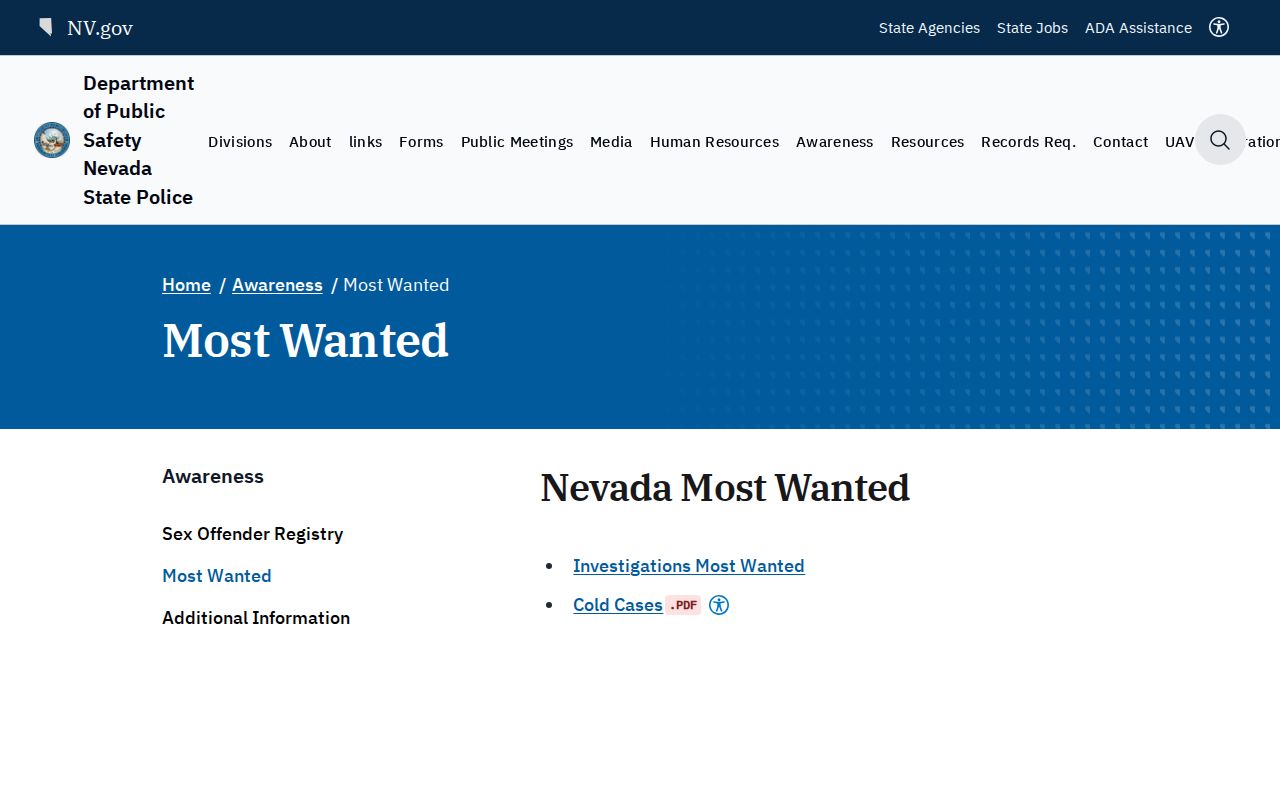
Absence from the Nevada program proves nothing. A person left off the page can still have a warrant. Any possible match still needs confirmation from the issuing court and the agency responsible for service.
Most-Wanted Lists and Roundups
Nevada publishes curated agency programs. There is no public roundup of every outstanding Nevada court warrant. The DPS Most Wanted landing page covers its own program only. Nevada Parole and Probation separately posts a fugitive roster for supervision cases. Its Warrants and Extraditions Unit manages that work. Neither roster is a statewide District, Justice, and Municipal Court warrant list.
Key Point: The Nevada DPS Most Wanted program and Nevada Parole and Probation roster serve narrower purposes; neither replaces a Nevada court warrant search.
The official agency controls its own roster. For an active court warrant, contact the issuing court even when a name does not appear on a curated program page.
Nevada Warrant Match Needs Court Follow-Up
A possible match on a local Nevada list is a starting point, not a court ruling. It is not a current decision by any Nevada judge. Verify before acting. A mismatch is not an all-clear either. Nevada's public warrant lists cover limited jurisdictions, and the pages rarely say when they were last refreshed. Use the court named in the case record. When the venue is unclear, the county directory points you to the right clerk. A Nevada active-warrant entry can flag a case. It may not show later action or service. Ask the clerk to confirm the signed warrant, any recall order, and its transmission to the service agency. Those details belong to the issuing court. One Nevada court does not search warrants held by another. Keep the inquiry tied to the case, and ask the court to explain the next step. A DPS-held Nevada record is a different matter. Send a narrow request through DPS Public Records under the Nevada Public Records Act. That route opens neither NCJIS nor a judicial records request.
- Record the court, county, citation or case number, and date from the paperwork.
- Ask the clerk or marshal whether the warrant remains active and which conditions apply.
- Ask how to request a copy or status if judicial access rules limit the underlying document.
- Confirm any recall order with the court and ask whether the service agency received the update.
If Your Name Is on a List
First, confirm the listing is really you. Check the name, court, and case. Then use the county directory to reach the issuing clerk or marshal. Ask whether the Nevada warrant is still active. Ask whether a hearing or surrender is required, how bail is set, and whether a judge would entertain a motion to recall or quash. Filing alone does not withdraw the order. Resolution rests with the Nevada court. It may set an appearance, accept court-approved bail, or take a direct surrender before a hearing. A sheriff's booking record is not the court's warrant record. Nevada judicial records follow court access rules. A releasable DPS record uses the executive-branch process instead. Court access rules and NRS Chapter 239 are not interchangeable. The Most Wanted page describes the official rosters without reproducing them. For a court warrant, get current instructions from the issuing Nevada court, and consider a Nevada attorney before arranging an appearance.
Important: A public listing is not a full statement of current conditions; confirm the Nevada warrant with the issuing court and consider counsel before arranging an appearance or posting bail.