
Nevada Arrest Warrants Start With Probable Cause
Nevada starts the arrest-warrant process when information reaches a magistrate. A complaint or affidavit usually does that work. Under NRS 171.106, the magistrate may issue a warrant once those papers establish probable cause that an offense occurred and that the named person committed it. Probable cause is just a threshold. It decides the warrant, not the case. The magistrate weighs the facts and signs, or declines. Nevada procedure also allows a citation or a summons when custody is not the route the state chooses. Venue and stage vary with the allegation. Anyone facing this should identify the exact Nevada court that would issue the order rather than treat every criminal case as an arrest-warrant case.
Arrest Warrants in Nevada
A Nevada arrest warrant is a magistrate's written command. It tells an officer to take the named person into custody and bring that person before a magistrate. It usually follows a complaint or affidavit laying out an alleged offense and the supporting facts. The question for the court is probable cause. Which court holds the warrant depends on the case. Nevada's court structure includes Justice Courts for many misdemeanors and preliminary felony proceedings, District Courts for felony matters within their jurisdiction, and Municipal Courts for city ordinance and other matters assigned by law. A citation or summons may replace the arrest warrant. Nevada arrest records and Nevada court records stay separate. The issuing court's docket controls the warrant order. On the search side, Nevada runs no public statewide arrest-warrant lookup; NCJIS is a restricted law-enforcement system, and no single public sheriff search covers court warrants statewide. That gap pushes the question to local channels. A Nevada police department, sheriff, constable, or marshal can explain its own service and custody records. Only the issuing Nevada court can confirm a warrant and its conditions. Use the county directory to find the right court and the local service channel. Verify there before acting.
Nevada Warrant Text Identifies Court and Charge
Nevada law fixes the core text of an arrest warrant. It creates no standard public search layout. Under NRS 171.108, the document must carry the magistrate's signature and name, enough information to identify the defendant, the issue date and place, the offense charged, and a direction to bring the person before the nearest available magistrate. That list covers the signed paper itself. It does not promise every field appears in a public docket. The official Nevada arrest-warrant statutes sit online. That page shows the Chapter 171 heading and the statute text itself. No real case record appears there.
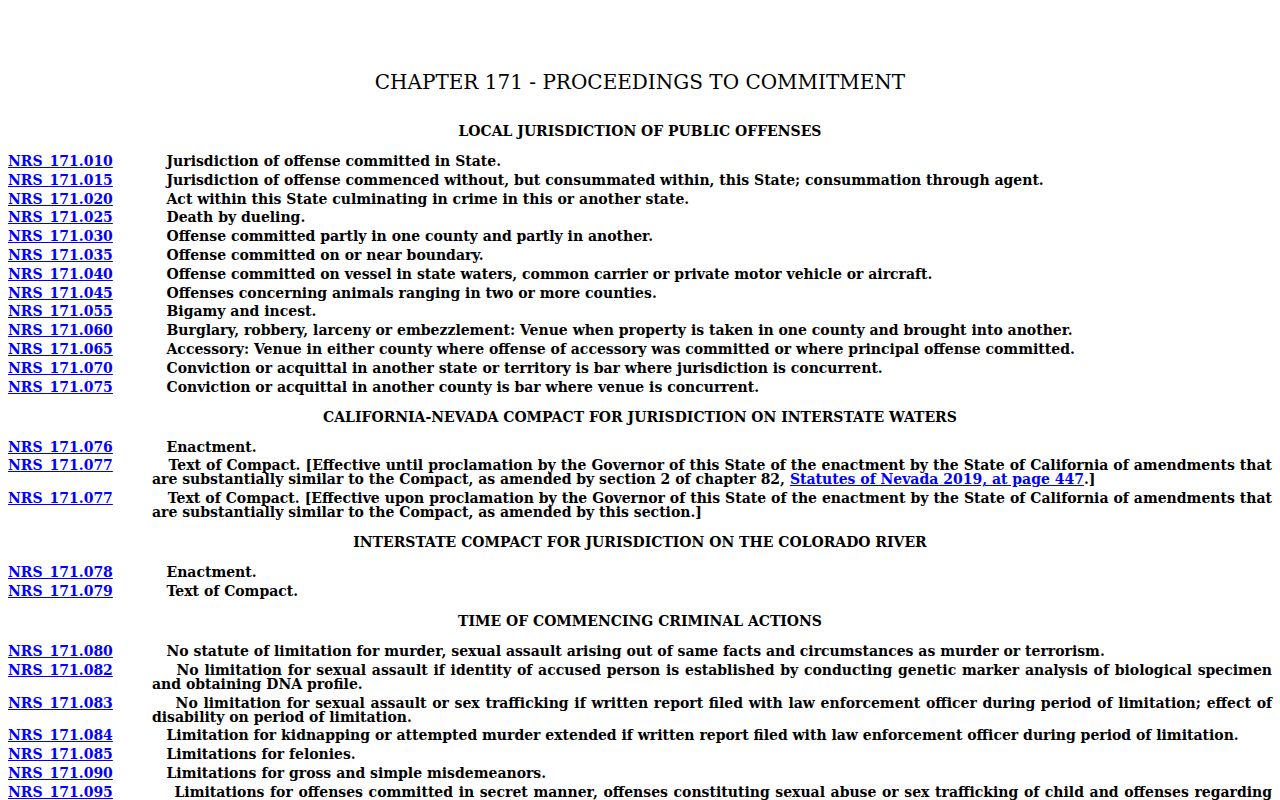
The statute sets legal contents only. It creates no Nevada warrant-number pattern, status code, or public list of active arrest warrants.
What a Nevada Arrest Warrant Contains
A Nevada arrest warrant is a court document. The statute lists what the signed instrument must say. Case numbers, warrant numbers, bond amounts, and current service status may sit in a Nevada court or law-enforcement system, and no uniform public statewide Nevada format for those fields exists.
| Magistrate | The magistrate's signature and name must appear on the warrant. |
|---|---|
| Named person | The document must identify the defendant sufficiently for the officer to know who is named. |
| Date and place | The date of issuance and the county, city, or town where it issued are required details. |
| Offense | The warrant must state the offense charged; the warrant itself is not a finding of guilt. |
| Command | The order directs that the person be brought before the nearest available magistrate. |
| Number, bail, and status | NRS 171.108 does not set a public statewide number pattern or result schema. Bail and current status must be confirmed with the court or assigned agency. |
These details tie the warrant to the person it names. They do not populate every public Nevada screen. A court portal may show only a docket event or basic case information. Ask the issuing Nevada court for the public portion of the signed warrant and its current status; a missing field never means no warrant exists.
A Nevada Arrest-Warrant Docket May Be Silent
An empty docket does not establish that no Nevada arrest warrant exists. Portals differ in what they cover. Some material stays sealed during an investigation. The Clark County District Court Court Finder in Nevada warns that warrant information may not appear in its online case search. That warning applies to one court only. Nevada's judicial access rules distinguish a docket event from confidential arrest-warrant paperwork and NCJIS or NCIC reports. Ask the issuing Nevada clerk what a party may see and how to request the record. The Nevada Public Records Act covers executive-branch records. A DPS request will not open a restricted law-enforcement return or a sealed Nevada court file.
How Arrest Warrants Are Served
Who actually shows up at the door depends on the court and the place. Nevada arrest warrants are served by authorized peace officers, and the assignment varies. The county sheriff, a constable, city police, or a municipal marshal may carry it out under Nevada law and local practice. Nevada sheriff duties and constable duties sit in separate statutes, and the Las Vegas Municipal Court Marshal Service is one city-court example of that division of labor. So the agency you call about a Nevada warrant may not be the agency that serves it. Nevada DPS/RCCD keeps the state criminal-information repository, yet it has no say in whether a Nevada arrest warrant issues or gets recalled. That call belongs to the court. After an arrest comes booking, a Nevada court appearance, and a release decision under the case order. Where you surrender, whether booking happens, and what bail is allowed are not uniform across the state. If the named person is outside Nevada, the issuing authority and counsel should explain any interstate or extradition issue. Do not read a warrant's geographic reach from an online entry.
Nevada Arrest Warrants Can Cross Court Levels
A Nevada felony case can move between court levels. It may start with a preliminary proceeding in Justice Court and later continue in District Court. The Nevada Judiciary lays out the District Court's general jurisdiction and the Justice Court role in its court directories. Each stage can produce its own case record or warrant order. So when you check Nevada arrest warrants, ask whether an earlier Justice Court file exists alongside the District Court felony case. The same goes for lower-level matters. Misdemeanor and traffic cases often stay in Justice Court unless a city ordinance or Municipal Court has jurisdiction. City courts keep their own Nevada case records and sometimes use a marshal service. Only the issuing court can confirm which arrest warrant is active. The agency named for service can then explain its custody or execution process.
Arrest Warrant vs Summons vs Bench Warrant
Nevada procedure uses a different document for each step. An arrest warrant authorizes custody after a probable-cause review. A summons directs a person to appear without taking them into custody first. A bench warrant follows a Nevada court obligation that was missed or ignored. The Nevada bench-warrant process grows out of an existing case, unlike a new probable-cause arrest warrant.
| Feature | Arrest Warrant | Summons | Bench Warrant |
|---|---|---|---|
| What It Orders | Take the identified person into custody and bring them before a magistrate. | Appear in court at the time and place stated. | Respond to the missed hearing or other court obligation. |
| Basis | A magistrate finds probable cause from a complaint or affidavit. | A case proceeds through a notice-to-appear route. | Failure to appear, comply, or meet another court condition. |
| Who Issues It | A Nevada magistrate under criminal procedure. | The court or authorized process in the case. | The judge handling the existing case. |
| How to Respond | Confirm with the issuing court, then follow surrender, appearance, or bail instructions. | Attend the stated hearing or contact the court promptly. | Ask the issuing judge or clerk about appearance, recall, or quash options. |
In any Nevada warrant case, read the actual notice and order instead of guessing from a docket label. A summons or citation gives you a chance to appear as directed. A Nevada bench warrant usually means an obligation in an existing matter went unmet. Ask the issuing court which document controls the next step.
Nevada Arrest-Warrant Check Starts With Case
Think a Nevada arrest warrant might exist? Start by pulling together the date, county, arresting or charging agency, court name, and any case number from your paperwork. If no court appears, ask the arresting agency or prosecutor where the complaint was presented. That is more reliable than an unrelated Nevada warrant search. A custody roster, likewise, is not a warrant index.
- Identify the likely Nevada court and whether the case began in Justice Court or District Court.
- Use that court's official public case route only for the fields and records it provides.
- Call the clerk to ask how a party can confirm status and whether any warrant papers are sealed.
- If service is assigned to law enforcement, ask the court for the proper agency contact and follow its instructions.
A public Nevada docket can be absent or limited even when a case exists. If the paperwork names no court, ask the charging agency which Nevada court received the complaint. Do that before leaning on an arrest-warrant portal search.
What to Do If There Is a Warrant for You
Facing your own Nevada arrest-warrant question, verify the court, the warrant status, and the conditions before you travel or pay anything. The District Court Clerk holds District Court files. NRS 3.250 makes the county clerk ex officio clerk of that court, though local office names vary. Justice and Municipal Courts keep separate Nevada records. The Nevada county directory points you to the right local court plus the sheriff, constable, marshal, or police agency assigned to the case. Ask whether an appearance can be scheduled, whether surrender or booking is required, and whether bail is set. Bail is a judge-set condition. It is not a fixed Nevada-wide amount. A lawyer can review the Nevada warrant file, contact the clerk, arrange a controlled appearance, or seek recall or quash where that option exists. Filing a motion does not by itself withdraw the arrest warrant. If the court orders bail, confirm the approved payment method and any hearing that follows. Once a Nevada judge signs a recall, keep the order and ask whether the law-enforcement record has been updated. The court decides the case. NCJIS does not.
Important: A Nevada arrest warrant may lead to custody during law-enforcement contact. Confirm the issuing court's instructions and consider legal counsel before arranging surrender or posting bail.